
Ensure User Satisfaction with a Proper Code Audit
A business needs to conduct a code audit or UX of digital products, websites, or apps. When auditing the code, all digital products have strategic stages of life cycle and development. This blog determines these key processes as to how and what needs to be expected from auditing of the web code. It also identifies how a code audit provides a more significant view, as compared to a normal code of products. 10 Situations That Require a Holistic Code Audit: There is a spectrum of reasons as to how a code audit can be worth it for a business. Every instance is considerably different from other cases. However, some cases can be highlighted from other recognized cases to identify their worth. 1-When Buying New Apps or Making Investment in Ones: A person is acquiring or has acquired a firm as a major investor. For this purpose, a code audit is necessary as due diligence. There can also be an instance where businesses have merged and their assets have apps or digital products with them. This product-wise and technology case requires conducting a code audit, enabling the firm to have a better understanding of their status. The comprehensive code audit and its results will determine a good concept about the state of the business functions. It will also support in answering the question as to how much finance needs to be invested in the application, particularly after addition to the firm’s portfolio. It can further support in answering as to how the product’s potential can be maximsed in a due course. Moreover, a code audit can be helpful when a business look for a part-business case, sell a business or make an investment. A broad audit allows in presenting the products honestly while determining all digital products in them. It also resolves the obvious problem of legal liability and similar other issues that arise in the future time. The above cases can better be handled through the code and UX audit simultaneously. There is a need for a full picture when conducting a code audit. For example, a complete guide with users’ needs is required for identifying all assets of the business. It is also necessary for determining the performance of markets and their way of influencing the business aim. A reality check becomes easy when conducting a code audit, particularly regardless of the situation. 2-As Part of the Risk Management Strategy: Every business’s plan and its major component is its basic risk management strategy. Every business is now confronting unforeseen risks, distracting them to fulfill their planned management goals. Therefore, an in-depth product audit is supported in viewing their possible flaws. Moreover, it can also influence the business applications while strengthening its business foundation. It then identifies threats of different types while making the business processes easier to be followed. Conducting a comprehensive code audit as a strategic risk management measure helps maintain and improve products’ marketplace positions. 3-Launching a New Product to Market: Launching a new product to market can be a challenging task to determine its overall purpose. Businesses need to assure that their target users will be availing of the chosen product considering its value. The code audit becomes critical and important, similar to the importance of designing factor and experiencing better. The factor of UX describes how a user trusts the new product while feeling it better. UX goes opposite with the purpose or simply creates fans for the new app. A challenge also arises when a business outsources the creation of digital products. There further rises the need for checking the application’s quality and its respective measures. 4-Security Check: The concern for a security check is a major need for every digital product’s owner. A security check for a possible vulnerability becomes necessary when users’ personal information is stored in the system. It mostly happens when the company’s app starts gathering, tracking, or storing sensitive data. Apart from users’ sensitive data, there rises a need for other different factors, such as mobile app permissions, passwords, email addresses, and other ways where users’ information is stored in the system. Such a checking system is a part of a pre-launching code audit. There could again be a factor of new malware or other viruses affecting the product’s app or website. A business then needs to carry out a code audit, as a security audit, to assure the products from standing apart and never falling from other best practices. 5-Users are Experiencing Problems: Users experience problems due to insufficient auditing or no auditing being done in the past. The reason could also include using the software in an unanticipated way. There also rises a problem of exposure issues that were not resolved on time or were unintended before. Whatsoever, it is time to audit if users are experiencing problems as follows: 6-Product is Being Scaling: An app working right on a small scale cannot give a guarantee of performance as good while thousands of users are connected to it. An audit becomes necessary when an app or website is accessed by 1000s of users. The right scaling strategy is to facilitate a new market or a large audience. A company may be having its app or website’s technical aspects and code up to the right level. However, there rise problems with the user experiences when a website loads for more than five seconds. The factor of mobile version also comes under a problem due to mobile-based bandwidth being unsupported for the respective countries. 7-To Avoid Technical Debt: Similar to the development work, it could be a difficult task to upgrade or change the app functionality with the user interface requirement. For example, modernizing the website or app or simply adding new functionality into it could have a technical glitch linked with it. A leading way to resolve this issue is to carry out a holistic UX and code audit. It becomes necessary to assure the product’s functionality is working fine as well as other complications being resolved
Optimizing Development Costs with Project Success Metrics

Every project is considered successful through some specific metrics. Some companies consider the factors of time, scope, and budget as their project constraints. Other companies focus on revenue generation, as may be expected from their projects. While there are a few other firms that consider the factor of complete customer satisfaction as their main achievement. Thus, many questions arise when it comes to considering the right project success metrics. It could be ultimately the marketing team, finance team, or SEO results that form the basis of a successful project. In general, the boundary of success could not be determined before all existing constraints are fully determined and worked on. Definition: The definition of a project and its scope need to be defined on time. The set up of successful projects start with determining how successful the project could be for all stakeholders. All criteria need to be focused on the specific goals or with a particular milestone. Companies need to be careful when selecting their valuable criteria. A focused idea is to prepare a list of success criteria initially, and then conduct a careful discussion and working on it thoroughly. Many projects have specific and similar successful criteria and metrics. These may include but not limited to as follows: Measurement: Reliable measurement of every selected and successful criteria could be accomplished with the involvement of all stakeholders. For example, stakeholders can be aligned with different roles, frequency of measurement, and other determined metrics. The afterward stage involves performing, tracking, and enforcement of the measurement process. For better accuracy, the measurement map should be defined with the involvement of the entire team. The three focused criteria should be taken into consideration, such as roles, frequency, and metrics. It will support in establishing the right expectation with all stakeholders involved. The final process is to focus on the project execution while identifying all areas of measurement. Documentation: Upon reaching the agreement on successful criteria, the next step starts with documentation and sharing of frequency metrics with all group members. It is necessary that every member of the team should have a direct agreement with the defined list. Otherwise, the successful boundary will have low flexibility and misleading result, thereby making the measurement ineffective for all. Current Snapshot: In a few cases, a project can become ineffective if its legacy system is undefined at the right time. Therefore, it is necessary to focus on the current state of the system while getting its image that is under enhancement. The above process will enable the team in making comparisons upon measuring of entire criteria. It is generally worked through working increment demonstration or sprint reviews. This strategic way can support the team in getting more conclusive results about the measurement. Continuous Monitoring: Continuous monitoring is the final successful metrics of the project. The process of having the success criteria identified, agreeing, and documenting does not end up here. The next role of the project management team is to track the success of the project. For example, the project risk assessment should be done to evaluate and ensure the entire success of the project regularly. The project’s risks have a direct relation to the success criteria, thus, mandating the project team to continue monitoring and evaluating afterward. It is also necessary to avoid any failure and to remain focused directly on the successful path of the project. There exists a spectrum of management models and approaches in the agile nature of IT projects. Some examples may include the Iron Triangle, Jobs To Be Done, the Lean Startup, and Scrum. Any of these should be selected properly to avoid failure of the project, thereby achieving a successful path and aligning with it systematically. Conclusion: There are different project success metrics that save development cost. Each of them should be defined properly to get a direct success of the project while focusing on basically determined criteria. These metrics should be applied and targeted to ensure a better evaluation of the project. The project should be initiated properly with defining measurement frequency. There is also a need of documenting the chosen success criteria and related metrics. Every member of the team further needs to agree on the chosen measurement frequency and documentation. Before the beginning of the project, the current state of the system and its image eventually become necessary as a part of the successful step. The next and final step is to continue monitoring the success metrics, such as tracking the project’s progress and evaluating the entire metrics continuously.
3 Steps for a Successful Cloud Migration Process
Nowadays, the success and failure of all businesses rely on technological innovation. Many firms have adapted to technical business, enabling them to grow and expand more technologically. Businesses are confronted with increased needs, requiring them to streamline their IT infrastructure in a more scalable manner. It is pertinent to note that IT infrastructure consumes huge costs, both on traditional demands and on-premises. It is because businesses need to constantly train the staff, update software, and buy and maintain new hardware. Before cloud computing, firms need to make a huge investment to remain updated with the technological trend. It mainly includes keeping updated with the latest capital and IT infrastructure factors. The inception of cloud computing has eliminated the above need of remaining updated with the latest technological game. Cloud infrastructure provides the capability of scaling IT-based infrastructure up and down, mostly based on the firm’s current demands. The best advantage of cloud migration is cost-effectiveness, security measures, and scalability. However, there could be great hurdles concerning the matters of testing, execution, and planning. A survey revealed that only 27% of businesses showed their extreme satisfaction with their entire cloud migration process. What is Cloud Migration? Cloud migration is the processing function of shifting business elements, applications, and data from the company’s computers to the cloud. It is generally an online network of shared resources that provide networking, storing, and computing services on a need basis. The firms having on-premises computing are more needed to migrate to cloud services. Cloud migration drags down under-utilized and outdated resources and subsequently makes the company’s on-premises system flexible and agile. It also rapidly adapts to the market’s needs, making them more workable with on-premises IT infrastructure. In other words, cloud migration provides numerous benefits, such as competitive edge, control, disaster recovery, mobility, scalability, security, and cost reduction. Cloud Migration Steps: Plan and Prepare for Migration: There is a need for better preparation before actual migration to the cloud. The level of preparatory needs depends on different businesses’ factors. However, businesses need to initiate some basic steps to migrate to the cloud. First, the reasons need to be clear as to why the firm is migrating to the cloud. The cloud provides several advantages, but every firm needs to be aware of the actual and right advantage that it seeks to avail. It is always a better idea to designate a manager for planning and overseeing the overall migration process. Amid a huge migration process, the company has to initiate several technical decisions and planning factors. It is pertinent to note that the success of every cloud migration project depends on the overseeing management of a specialist. There exist two ways to migrate applications to the cloud, particularly while moving applications from the on-premise data center. These are deep cloud integration and shallow cloud integration. In the shallow cloud integration, the process involves moving the on-premise applications to the cloud-based system. It is also called the “lift and shift” system where applications are run through the changes made in the server system. The application change is simply accepted into running in the new environment. In this process, cloud-unique services are not used for better efficiency. This strategic process is called “lift and shift” because applications are started lifting and shifting to the cloud interaction. In deep cloud integration, the process involves modifying applications amid the migration process. It also involves taking advantage of key cloud capability while remaining simple in the use of dynamic load balancing and auto-scaling. It is as general as using serverless computing capability for the partition of applications. Choose Your Cloud Environment: Before starting the cloud migration, it is essential to choose the right cloud model for a better adaptation. For example, the company needs to decide whether it will prefer a multi-cloud environment or a single-cloud environment. A single cloud environment is encompassed with the use of a single-based cloud migration service. It is a provider that serves a single application and service that the company makes a decision when migrating to the cloud. It can facilitate either public clouds or private clouds, particularly based on the business’ future and current demands. Moreover, it lets businesses shift moving their workload to the cloud as the need grows. There are also options for expanding the range of virtualized servers based on a single cloud and its server-based limitation. It is often noticed that businesses with a single cloud model apply cloud-based single service/application. These mainly include customer relationship management (CRM), enterprise resource planning (ERP), email, or related ones. A multi-cloud environment is encompassed with several public cloud services. It includes organizations using multiple different providers. A varying cloud is utilized for different tasks to be achieved, such as reducing vendor’s locked-in or best-of-breed result. It is again pertinent to note that not every cloud is developed equally. For example, cloud services relating to sales and marketing might have different requirements, as compared to R&D or software development. In general, different cloud solutions have the capability of meeting such needs much efficiently. This type of cloud solution benefits companies with more added peace of mind, such as through minimization of dependencies on a single provider. These may be supported with both increasing flexibility and decreasing costs. Cloud services offer different service factors through a single focused service. These may include Software as a Service (SaaS), Platform as a Service (PaaS), and Infrastructure as a Service (IaaS). The cloud-based other service factors may include Testing as a Service (TaaS), management, security, integration, application, process, information, database, and storage. Migrate Applications/Data and Then Review: The general migration process goes quickly and smoothly. It involves a carefully planned migration process, letting firms to decide on their migration needs successfully. The decision is made based on the size of applications and databases. Different techniques are used in copying the data from manifold resources. If there is not much data available in the company, then it can simply migrate by copying pasting the data and information.
How Can Cloud Computing Supports Your Growing Business
Nowadays, firms have been continuously adapting to cloud technology. It is a basic idea to incorporate into the capability of accessing storage capabilities and distributed computer processing. Under a 2016 poll, it revealed that 41% of companies plan on adapting to cloud technology. Now large firms are accepting trends of getting fast, as compared to their rival companies. Comparing to 35% of small firms, cloud computing firms account for up to 51% of large corporations. Cloud technology is effective in enhancing operational efficiency and customer-driven service for all businesses. Every firm now adapts to cloud technology because it enables the workforce to work remotely while saving huge corporate costs. Around 64% of surveyed firms determined their keen interest in cloud technology due to its ease of convenience and economics. They claimed that they are happier to allocate increased budgets for their cloud computing needs. Improving Operations: With growing needs, cloud technology helps firms in scaling their computing solution. It is a past practice of forecasting servers to be purchased for the business service. Now firms no more keep hiding servers to expand their business practices. Firms have now been altering their usage with cloud providers. These may include high powered service solutions from Microsoft Azure or Amazon Web Services. The cloud provider is in the practice of identifying more finance, charge, and space for the respective business. However, the firm can decrease their usage based on their decreased requirements of computing resources. The business now fulfills its computing needs through the cloud technology scales. A complete host of the new application is now opened up for businesses, enabling them to fulfill their large firm-based cloud technology needs. For example, Business Insider determined that Toyota leveraged its cloud-based technology for transforming their cars into a “connected platform”. Toyota also used Microsoft Azure service for hosting its app network while connecting their cars to Facebook or rewarding “eco-point” to use as an electric vehicle. Supporting Customers More Effectively: Apart from creating valuable apps for customers, cloud computing technology allows for better-oriented customer support services. There is no more practice of a single employee handling phone calls from 9-5. Customers now demand a rapid answer and purchasing need all day long. Cloud technology is the best resource for business-driven needs. It enables employees to access the same recorded services and information while providing direct customer support all day long. The customers are believed to come to a single platform to receive all their support services. The customer service is specifically provided with more strong connections and relationships. These may particularly include the use of the desktop computer, laptop, or mobile device. It allows for more room for customer service while sharing the same information from everywhere. Even the small business is now in a growing practice of fulfilling customers’ need for high-bandwidth and high-quality information through cloud computing. Enabling a Flexible Workforce: The company adapting to cloud computing technology also creates benefits for their employees. The workforce can work from home particularly with the shared information stored online. A Gallup poll revealed that there was an observed 37% increase in the workforce been working online in 2015, comparing to 9% in 1995. In 2010, many firms transformed their business practices into cloud technology. The average workforce is believed for telecommuting two days per month. It is cloud computing that has enabled the workforce to work from home, particularly with their right connected information. The cloud has enabled working through Bring Your Own Device (BYOD), thereby letting employees work from home for more than one company. Saving Infrastructure Costs: Firms have been benefiting from decreased infrastructure costs due to employees’ working from home. There are fewer desks needed to be availed when the workforce prefer rotating from office-based work to home-based employment. An example is Zapier Company that experienced its startup working through entire remote working. Zapier’s business model no more needs the maintenance of an office-based building. It saves the company’s lot of finances while lowering the cost of starting a successful business. The other cost of services, such as purchasing computers and servers, are also reduced with its startup process. These are particularly supported through the cloud computing technology of AWS and Azure. The cloud-based service is also beneficial for entrepreneurs and startups. It mostly supports the service of API integration that many startups avail for their better processing of operations. Another example is customer relationship management (CRM) software that enables startups to integrate their accounting software into their business practices. Different software as a service (SaaS) firms have been highlighting such integration as a great business advantage. This service also ensures scalability for businesses, making them a more focused cloud-oriented company. It finally supports businesses to get a cheap and less capable service, thereby expanding its business horizon beyond their business development needs. Storing Data Safely: The security concern becomes essential for all small, large, and medium-sized companies as they start adapting to cloud technology. However, safety is quite recorded in cloud services, determining that security is not the top concern for firms anymore. An example is the Toyota Company that safely stored its data online while turning cars into connected devices. Toyota’s adaptation to Microsoft Azure led the firm to dedicate its security much safer while performing cloud-based data storage services. Cloud service is continuously working on its security measure to fulfill the needs of its customers, thereby making the security issue less concern nowadays. Increasing Productivity: Direct investment in the cloud enables companies to offer a central repository for every of their information, processing, and communication. This strategic central point enables the workforce to work from any part of the world. The workforce and customers can connect online 24/7 through the use of internet-connecting devices. Cloud services increase productivity by saving financial resources. The workforce can conveniently connect to customer relationship management software. Many startups are believed to generate huge productivity through cloud services, making them adopted more easily and favorably. This financial privilege
The Rise of Progressive Web Apps (PWA) and Its Benefit for Your Future Business.
Nowadays, the technology industry is making huge investments in innovative web solutions. Progressive Web Apps (PWA) has increasingly become more prevalent due to its fullest support with Opera and Chrome. Similarly, iOS, Microsoft Edge, and Firefox are also supporting PWAs with immense progress, creating the best experience for all. PWAs are now getting increased support from different major brands that seek the fullest benefit of their capabilities. For example, Twitter has made a great investment in ensuring its web experience with response to progressive web apps. It has resulted in a fast user experience with an improved interface-based link. Pinterest and Facebook have also joined hands with PWAs to get a streamlined user experience. The PWA landscape is highly transforming the e-commerce businesses while remaining higher on other firms. These particularly include the Weather Channel, Pinterest, Washington Post, Starbucks, and Twitter. These entire firms have recently applied the launching of their web apps through PWAs in the preceding six months. What are Progressive Web Apps: PWAs stands for apps which are easily installed on the system. They involve previous interaction in using the cached data. They ensure the operation being done offline or without an internet connection. They work similarly to websites that perform well like native apps. PWAs possess functional operations similar to a native app. They are easily managed in delivering the usability of different websites. They are effective in mitigating a spectrum of issues that range from an overall lack of connectivity to data obstruction or an inadequate network. PWA Benefits for Your Future Business Rising Consumer Expectation: It is observed that consumers have a low tolerance for different brands, particularly having a poor digital-based experience. The customer gets a spectrum of choices at their disposal, making an easy move on to other brands. This gives an underwhelming experience to customers, making them again reluctant toward the use of a specific brand. Starbucks and Pinterest started launching their PWAs with a noticeable increase in interaction with their customers. For example, Pinterest achieved a 60% increase in its mobile interaction. It also achieved quicker page loads while gaining a streamlined mobile experience. Similarly, Starbucks achieved a great web-based order management experience for its coffee-drinking customers. Native App Like Experience: PWAs offer a reliable and adaptive interface around every device. They start loading similar to a standard website while giving an advanced-based native mobile experience. They include the capability of adding a one-touch solution to the device’s home screen. They operate offline while also allowing for different types of push notifications. Moreover, PWAs provides website benefits that are related to search engine optimization. They have even the capability of accessing modern web browsers while providing a generic experience for all users. Alongside native mobile applications, PWAs have been appearing in the Google Play and App Store with having numerous features in them. Reduced Resources and Expenses: PWAs provide a streamlined coding experience that result in reduced resources and expenses. They require only one code base for providing mobile/website app-like experiences around different devices and browsers. In short, they require only one team in running through digital devices and products. They are mainly consistent with one test approach and simply work with one software platform. PWAs are helpful in reducing resources and expenses through different measures. On the other side, PWAs are effective in planning, designing, creating, and managing both mobile and website app-like experiences. They are highly recognized for reducing costs of maintenance, development, and design of the product. They finally save money and resources for companies while enabling them to have a quick delivery of newly derived features. Adaptive: PWAs highly support innovative brands in today’s changing technology. They provide an incredible speed for a better performance of the website and mobile app. They implement highly advanced forward-looking technologies for omitting an increased cycle of strategies. They again support in designing, producing, and re-constructing digital solutions. PWAs continuously change to fulfill the newly arrived functionality and improvement. They are fundamentally versatile, meaning that they work efficiently with the website or mobile app frequently. They are supportive in determining the basic needs of a native mobile application or a legacy website. For example, PWAs work for years to provide a win-win solution. PWAs are continuously building for transition, assuring that firms need not invest in a less user-friendly mobile app or one-off websites. They are continually monitored to ensure well and re-designing in order to work proficiently. They evolve around the brands to meet the demand and technology needs of customers. Streamlined Web Experience: Google considers PWAs as great web experiences. It is mainly due to PWAs effective functioning with the faster page loading, cross-browser compatibility, and ease of access. PWAs are quite supportive in leading the firms to achieve a high level of user experience while impressing customers and getting them hooked. Additionally, PWAs are reliable in loading instant pages and showing the website with a single click. It works even under predictable network conditions. They are fast because they respond easily to user interaction. They avoid janky scrolling while providing a silky smooth animation. They are reliably good to enjoy an intuitive user experience due to their functioning and engagement as a normal app. Enhancing User Experience: PWAs provide progressive enhancement that result in an enhanced user experience. A strong PWA solution is effective in increasing the pace of technological capability. They empower firms while adding the right solutions for businesses. The launch of PWAs has derived several companies to enjoy a leveraged web experience. It has powered the web platform to a great extent, thereby reaching newly developed marketplaces and enhancing their user experience. In fact, WPAs are simply very easy to be developed, tested, maintained, and post deployed as and when needed. Increased Page Speed: It is obvious that there has been a considerable decrease in the speed of mobile page loading, such as from 22 seconds to 15 seconds. However, it is still lacking the need for customers because they are readily looking
A Step-by-Step Guide to Testing Healthcare Applications

Nowadays, the health department users or quality assurance (QA) specialists necessarily test every healthcare app. Quality assurance has become a leading step in making the healthcare app workable in the medical industry. It is done mainly to ensure a positive experience for every healthcare receiving user. The systemic process of testing healthcare applications through a quality assurance team enables a seamless working of the healthcare app. Another major objective of the quality assurance check is to assure the privacy of users’ personal data. This prime purpose has now become a leading step in working closely with healthcare regulations and norms. It is pertinent to note that the process of testing any healthcare app is different from the testing of other software products. The app developer needs to focus mainly on the major required tools of testing, such as a step-by-step guide on the ways of testing. It also includes focusing on healthcare revealed soft spots of checking healthcare apps. It may further include the way of choosing the right QA team for testing the healthcare app. Soft Spots to Be Checked When Testing Healthcare Apps: In the medical industry, there exist different kinds of healthcare apps. These healthcare apps manage different valuable and sensitive medical data and information. It is the reason that such healthcare apps are focused on more soft spots as compared to other applications. The following is brief information about the vulnerability and potential weaknesses of all healthcare apps. Failure to Comply with HIPAA Requirements: HIPAA compliance checklist is a major tool when checking the reliability of a healthcare app. Throughout the entire product lifecycle, the HIPAA checklist saves a healthcare institute from facing huge penalties and fines. It also saves from possible cyber attacks and data breaches that mostly happen with the patient or client-driven data and information. Below is a small checklist of HIPAA compliance rules that need to be followed: · Role-based Access Controls Working Properly: It is necessary to ensure that every role is well-defined in the accessed scenarios. Another responsibility is to ensure that only prescribed data is provided to every user. · The App Offering Secure Authentication. It includes working through a multi-factor authentication system. It also encompasses risk-based authentication, short-term passwords, and biometrics. These entire functionalities enable providing every user with a higher level of protection. The QA team further necessarily has to check the app concerning its better functionality and processing for all users. · Encryption of Protected Health Information (PHI): The process of encryption is an easy manner for securing sensitive information. Every QA engineer is required to check the processing of encrypted information and decryption for better security. The PHI needs to be secured with proper keys and their proper way of storing and functioning. · Data Backups are Automated: There is no requirement for an automated data backup in HIPAA. The manual backup also consumes a lot of time and can be forgotten. Every user needs to automatically back up data using a particular data manipulation or a certain frequency. The QA team must check if the backup is successful, particularly after meeting all the conditions. User-Unfriendly UI and UX: When it comes to app testing, user satisfaction is of great importance. The satisfaction is influenced through three main criteria, such as effectiveness, efficiency, and usability. The first phase is the usability evaluation plan that the QA team starts when testing the app. It helps in ascertaining whether the developed healthcare app is easy to work with or user-centric. The main areas covered in the usability function are usability goals, usability metrics, usability tasks, and usability roles. This strategic plan helps in mapping out the basic approaches to testing user experiences and user interfaces of the healthcare app. The conduct of an expert review is the next step to initiate hallway usability testing. This type of testing enables every tester to identify the actual time that a potential user will take to complete the app-based tasks. For executing such a role, the QA team selects randomly a user who is focused on completing a few actions with the healthcare app. The aforesaid type of check-up supports the QA engineer in finding any issue and inconvenience that may be hindering the app system. Afterward, the QA engineer checks the entire healthcare app from a technical perspective, thereby providing an entire experienced and expert review. Incompatibility with Medical Systems: A major thing to be checked while testing a healthcare app is its interoperability. It is checked between the third-party healthcare software systems and the healthcare app itself. This type of software may include medical practice management software (MPMS), hospital management software (HMS), and electronic health record (EHR). It is pertinent to note that the integration of third-party software generally makes the healthcare app much convincing and usable for every user. The challenging part of interoperability is that all hospitals and their software can effectively utilize their system. These may include properly working with functionality logic, database type, and data format. This type of lacked uniformity, particularly with the legacy system, forms more layers of future problems. Therefore, the QA engineer must ensure checking the healthcare app concerning communication matters, thereby making the app integrated and working fine with the entire system. Incompatibility with Wearable Devices: The healthcare market is truly flooded with low-cost wearable devices. There is now observed an attraction of new audience and giant market shares, such as from smart glasses, wearables, smartwatches, and fitness trackers. The healthcare app is likely to function properly if it is supported with external tracking devices. However, it might be a point of friction to observe the working of wearable trackers with that of the healthcare app. Among the major problems relating to wearable devices, the app is unable to be seen as devices working properly. For example, these include devices connecting but are not transferring data, devices seeing but not connecting, and apps not seeing as devices. To avoid such issues and remain customer-focused, the QA team must
How much does it cost to build a Web App for your Business?

The transition of businesses from bricks and mortar to operating online has been on the rise since the start of this century. Not only does has this transition been convenient to the customers, but it has also helped businesses to market their products to various audiences worldwide. However, one of the most vital aspects of having success online is to create a web application that is convenient for the customers. A web-based application is a web-based software which runs on the internet server which helps entrepreneurs to keep a track on their brand’s sales, information and audience. These web applications are easy to use and can be accessed via a smartphone, tablet or laptop. Is it expensive to build a Web App? The cost of building a web-based application comes with a lot of uncertainties, one of which is how much it actually costs to build one. Web App developers often charge on the basis of the business’ requirements. These web-based applications need to be engaging, efficient and diverse. The more features a business requires on the applications, the more expensive it gets. In often cases, the cost of building a web app also depends on the size of the business and the audience. How to get the best use out of Web Apps? Using web applications can be extremely tricky. Online business owners often end up spending a lot of money on these applications in order to get the best use out of them. However, throwing big bucks at web app developers may not be the answer. The use of these web applications depends solely on what is required from the business. It is extremely important for business owners to analyze what functions are required from a web app so it makes the user experience fun and engaging. A new business owner should always go for a web app with minimum functionality and develop their web app as the business grows more in the future. This ensures the survival of the business in the short run as the business does not have to incur losses, whilst making profits.
Complete HIPAA Compliance Checklist for Your Software Product

An important law encompassing the medical software products is now the 1996 US Health Insurance Portability and Accountability Act (HIPAA). Businesses failing to adhere to HIPAA are required to give payment in a heavy fine. The firms and organizations were charged huge fines in 2018, making up to $28,683. The Office for Civil Rights has necessarily imposed fines to the firms that ignored the HIPAA checklist. The companies are now required to be careful in completing the HIPAA compliance checklist for their software-based products. It can save them from applying a hefty fine that is now charged to HIPAA ignorant companies. Introduction to HIPAA: HIPAA was enacted as a leading act and with the main objective of establishing focused rules. It included the destruction, exposure, transfer, usage, storage, and gathering of medical data from every kind of medical establishment. It also affects companies that have access to medical data with them. The main requirement imposed by HIPAA is now governed by all data protection rules on behalf of every patient, allowing them to initiate an informed decision. HIPAA is dissimilar to other acts in the industry that is important for all companies. It is an important rule, but it has power merely for the U.S.-based territories. However, the companies transferring their data out of the U.S. territory are truly exempted from the HIPAA protection act. Every company is required to understand the main terms in order to be completely HIPAA compliant for its medical software. HIPAA Compliance Checklist for the Software Product: HIPAA necessitates the use of mainly reliable technology for securing the software and relevant data. However, HIPAA avoids naming the exact tool or technology. The governors of law made a decision not to specifically state the selection of technology which happens to be outdating within a year or two. It means that the companies have a wider choice in selecting the security feature, toolset, and technology means, as may be requiring for projects. Nevertheless, all healthcare software companies or related software have to meet the set forth a list of HIPAA needs. The law has established a clear checklist that is required for making the companies completely HIPAA compliant. Strictly Control Access: Around tons of ePHI is processed by any software product. However, every employee is not necessitated to do the same job or get access to similar data. The companies are required to ensure strict control of the access to data, as may be needed by specific employees. It can subsequently help the firms in protecting their data from malicious intent. There also raises the possibility of saving software data from unnecessary human errors. Pro Tip: The software needs to be implemented on a role-based system as it can lead to restricted access of data to the employees. The companies should define every specialist with the specific data that may need for the product work. These not merely include a nurse or a doctor rather the access to data should also be given to specific technical staff or administrators. After defining every type of user for the software, the companies should then create a list of the kinds of data that may be requiring further access for better performance. In HIPAA, it is a good idea to limit workers’ access to data. However, if a particular employee, administrator, or specialist does not have access to necessary information, it can be requested for onward access and subsequent control. Limit Session Times: According to HIPAA, the session times should be limited to improve the security of PHI. For example, every user should be automatically logged out of the software system following a specific time. If the employees are not using the system, then they should also be logged out of the system automatically. It can help in protecting the information and software that are unauthorized to a third person. Pro Tip: It is pertinent to note that the companies should not create session times the same for every user. For example, few users should be given long time access to session if they need to work for a longer period. Such prevention from unauthorized access is a wise strategy in making the device being supervised in the right manner automatically. Encrypt Data: In pursuant to the HIPAA compliance act, it is an optional step to define PHI encryption. It is a choice for the companies whether to encrypt data or not. The only concern and important factor is data security under the HIPAA act. For example, the companies can select different approaches for protecting their data from unauthorized access, such as tokenization. In general, medical information is better protected from such a fast, easy, and convenient way of data encryption. Pro Tip: It is necessary to apply the most reliable encryption protocol for choosing encryption upon other security approaches. In short, the encryption should fulfill the needs of the National Institute of Standards and Technology. Moreover, the keys to the access of data should also be placed in an accessible location, so as to ensure the most reliable encryption. Implement an Activity Tracking System: HIPAA requires companies to implement an activity tracking system. For example, the software system should be executed in a manner that it could have tracking capability, such as accessing users’ activity. It should be done on a regular basis to identify individual patterns. The above consideration can help the firms to run their system while detecting suspicious actions. It can also alert firms about different types of malicious intent. It can further be useful in identifying data theft and data breaches while preventing them with complete authority. Pro Tip: The tracking system is not merely supportive in preventing breaches rather it is also effective in investigating accidents, as may be occurring due to the security breach. The companies should record every action and ID of the workforce. This action can help in conveniently finding out as to which employee worked lastly on the system and as to how a hacker interfered in the system
Golpik Inc. Achieves Their First Review on Clutch

It’s 2020. Every business should have an established website by now. In a world where personal connections have been replaced by online connections, it’s not really a surprise that the world of business shifted alongside it. Humans have adapted and lead a more digitally-forward lifestyle so the natural reaction would be to move your business into the internet. Web development has now become a prerequisite to increase your company’s visibility and for your message to be heard. But it doesn’t stop there. Smartphones have evolved their features to become more than just a means of communication. It has become a dominant digital platform as more and more people are putting their heads down to swipe their phones. Now there’s another path you need to consider to boost your signal and take advantage of this vital business opportunity. More eyes on your company means an increased opportunity to acquire better leads. It’s really a no-brainer to adapt this handheld technology to elevate your business to a higher level. Lucky for you, Golpik Inc. specializes in both web development and mobile app development. We consider ourselves a hub for technology driven and creative workforce. We provide intricate solutions to bring long-term success and take your business to the next level. We approach every opportunity to work with you with passion, professionalism and we make sure to put all your needs forward. It gives us great pride to know that our work affects our clients in a big way. That is why we are happy to highlight our first review on our Clutch page! For this particular project, we helped a home funding company in developing their website through WordPress. We also provided the maintenance and update of some of their features. “It was quite easy, and we got the job done in a timely fashion. It was also priced well for what they had to do.” -Barbara Smith, Bookkeeper & Controller It’s honestly quite flattering to be credited as part of your client’s success. The experience working with the people you enjoy working with is unmatched and can never be duplicated. We’re also featured in Clutch’s sister site called The Manifest. The Manifest is a company listings website that compiles, analyzes and categorizes businesses based on their performance and client impact. Are you looking to implement web and mobile app solutions into your business? Schedule a consultation with us today and we’ll help you figure out how you can become more visible to your target audience!
6 Key Advantages of Outsourcing a Software Product
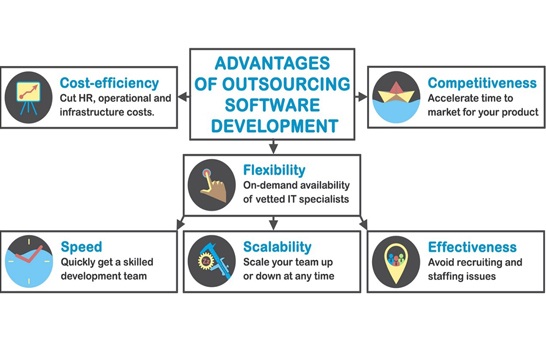
If you are employed to create any new product from the beginning, consider a strategy where you can complete a task in-house, or you can opt for outsourcing model which lets you assign your important task to a professional team. These two options catering to your development task has its weaknesses & strengths. This depends on the situation & the type of task you are involved with. So here in this post, we will be discussing some of these points side-by-side in comparison to deciding the best option. 1. Work with of Professional Team This must-have crossed your mind that outsourcing a project to an external team has huge risks involved in the process. But a professional team who undertakes your task, also care about your reviews because that impacts their market reputation. The professionals of the IT world only aim for quality & a smooth process. When you are charged for the high-quality professional work, the team on the other end is responsible for final results & risk management. 2. Minimized Costs When you invest your trust in an outsourcing company, you save a lot from infrastructure & operational costs. The salaries are comparatively lower in some countries & outsourcing provides some great significant benefits & options to cut expenses. 3. Competence The corporations you trust online for your outsourcing work must have skilled professionals on-board and many other factors involve which describe outsourcing company strengths such as, professionals have experiences of working with more significant projects & for businesses of different arenas. Their experiences enable them to have a broader understanding of markets & business requirements. So, you are plain sailing towards your required product just by outsourcing your software. 4. Simple Partnership If you are working on a software development project, then you must be loaded with tons of information. This might be regarding the project progress, information transfer, clean communication & supply team with every detail they need. Your outsourcing firm will now be in charge of all of this, so you are free from all hassle. 5. Time-Saving The best part about utilizing the outsourcing benefits is that it helps you get some free time on your end. This time can be used for some other important activities related to your business. In the long run, this will impact on company’s core business plans & procedures. Find yourself enough time to invest in brand marketing & let a professional team take of your work. 6. Absolute Results The company or individual you are trusting for your service is always looking for a chance to create a well-known impression. This makes your outsourcing partnership even more impressive because the other person is putting in a lot of effort to create a product to blow up the market. They dedicate their immense creativity to build a product, from designing to tunning, fixing & relaunching. So, if you have invested your trust in the right outsource partner, then it is more likely to help with a smooth delivery process, a better quality of work & save your time for other productive matters. We hope that you are convinced to outsource your next software project online.