
MVP vs. Prototype: Ideal for Validating Business Ideas?
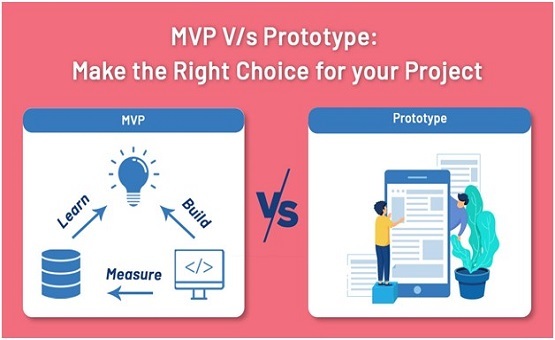
The start-up businesses are required to undergo a spectrum of stages for launching their final product. Among all, the stage of idea validation is the most leading factor to finalize the process. The comparison of a prototype and an MVP (Minimum Viable Product) are of great importance throughout many businesses. The approaches of a prototype and a minimum viable product are supportive in leading the businesses through different stages of product development. It is important to note that people frequently get confused with the definition of an MVP and a prototype. The right usage, accuracy, and comprehension of these methodologies can generate corporate ideas in a well-structured manner. It can lead the respective users and stakeholders to understand the business concept in the right manner. It can then improve the successful outcome of all future products’ launches, thereby leaving no chance of failure or obstruction in any way. It is again necessary to understand that the prototypes and MVPs have different objectives that need to be used at a different product development stage. There is also a possibility of combining the approaches of an MVP and a prototype, leaving again no chance of distraction among them. Prototype V/s MVP A prototype is simply the beginning of a material, such as a model or a sample, which is later purposely designed for a better business concept. A prototype is the releasing process of the products that are designed for testing the concepts or processes. These are later acted as the major things to be learned from or replicated. On the contrary, an MVP (Minimum Viable Product) is a basic product that has a limited feature to be satisfied with the basic need of consumers. It has also enough features for providing feedback for future product development, giving a limited rise to more product development opportunities. What is a Prototype? A prototype is used in the early stage of startups’ product development. Its purpose is primarily to conduct a presentation and identify user testing. Upon presenting the prototype, it is possible to gather a few funds for the developing phase of the Minimum Viable Product. The afterward process is complex as the lifetime of the overall functional cycle gets terminated on the later stages of development. It is again important to note that the primary level of stakeholders and users can get valuable feedback from the entire process. In case of getting negative feedbacks, the prototypes can be altered and tried again at a later stage for better product development and finalization. On the contrary, the strategic approach of MVP is utilized for testing the startup idea for gaining better efficacy. It’s another purpose is to get community feedbacks that are later utilized in the development of a business idea. This tactical process enables in getting a huge and raised sufficient level of funds that are later rolled to the products’ marketplaces to the diversified people. However, if the planned ideas seemed invaluable for developing the product ahead, then it could be stopped in any way. Such a stoppage of the process does not consume any deal of time and money while it lets the process continued at a later stage with a much-deliberated process. What is an MVP (Minimum Viable Product)? A Minimum Viable Product is considered a fully-fledged product, meaning that it is readily delivered to the markets. It is the right way to consider whether the products would have a value for the consumers in the markets. Additionally, it requires a lot of consumers’ feedbacks from the target audiences. Unlike a prototype, an MVP expects intense technical development. It is owing to the reason that its functionalities could have a possibility of adding, particularly at the final stage of product scale. MVP vs Prototype: Which is Best to validate: Both a prototype and MVP are quite supportive to validate and verify the assumption of the product. They initiate a major performance in the development phase of product recycle. Their comparison is of great importance when it comes to bringing them into the product development stage. An MVP and a prototype describe how and what could be developed from each stage of the process. However, it is noteworthy that they have different goals that are initiated in the designing flow of the process. The product prototypes are truly displayed with the functions when needing the operational measures. In contrast, an MVP is mainly the functional product over the development stage. It is truly simple in the systemic process and is made available to the markets. Concerning the product development phase, an MVP has extended ways for enhancing and scaling the product. Concerning the above statement, it could be determined that a prototype requires the basic testing and assumption of the product. It has a different way of showing the users about the early investment referring to the business processes and ideas. These entire considerations are aligned in the development phase of the product. Such considerations increase the investors’ confidence about their money being invested in the prototype and MVP of the product. The investors understand that their money will give a worthwhile true business idea. Regarding an MVP, it is not a sketch and is a less functional product. It requires the less functioning need to finalizing the product. Such a feature of the MVP product requires less implementation and monitoring. Every prototype bears a product idea for the development stage. The only consideration requires it to check its working capability with every stage of product development. The product prototype is the next phase where the startup development process is initiated to move the product in the afterward stage. The overall systemic process then leads the product toward the functional stage. From there, the product’s reliability is assessed in terms of its functionality and finalization. Thus, it is said that a prototype is highly considered as the prime implementation need of the future project. It is simply a sketch that is primarily meant to determine the investors about their